Turning Data into Decisions: Research-Driven Remediation Plan for Bayombong Sanitary Landfill
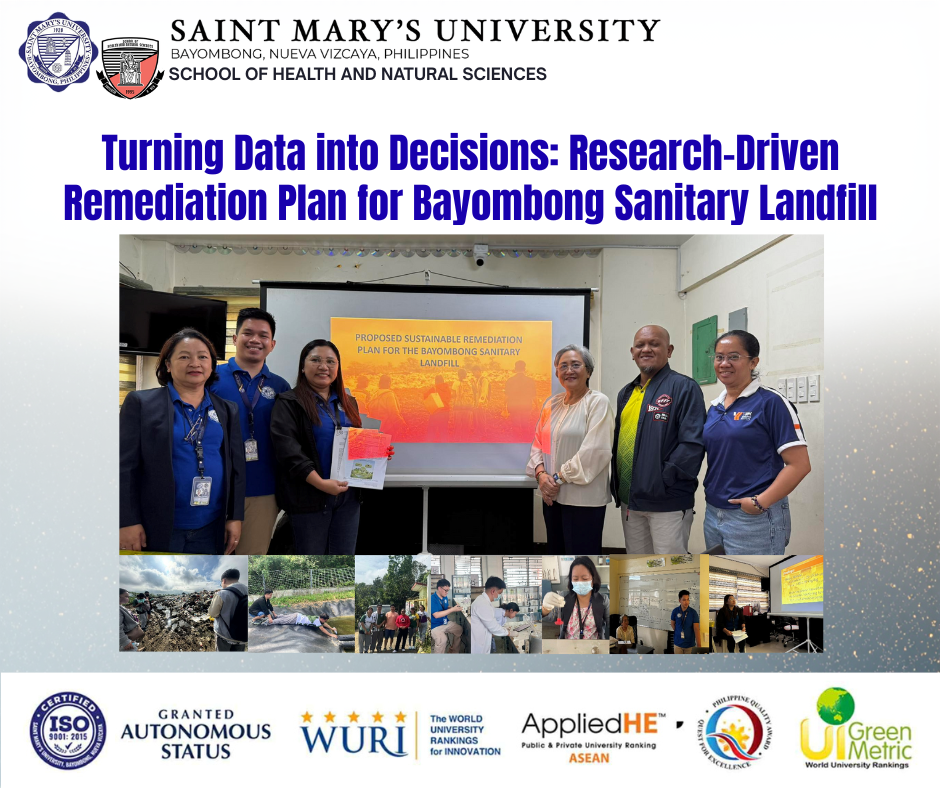
Evidence-based research took center stage as Saint Mary’s University (SMU) formally presented its research-driven remediation plan for the Bayombong Sanitary Landfill to the Municipal Environment and Natural Resources Office (MENRO) on January 28, 2026. The initiative highlighted how scientific data can directly inform local environmental governance, strengthen waste management practices, and safeguard public health.
The study confirmed that current landfill management systems are generally functioning well, with cadmium and lead levels remaining below hazardous thresholds. However, the research also identified areas needing improvement, including slightly acidic soil conditions and uneven nutrient distribution in surrounding areas. These findings became the foundation of Project Salun-aTEM (Sustainable Actions for Landfill Upgrading Nurturing a Transformative Eco-landfill Management), a remediation framework that promotes targeted soil pH correction, nutrient enhancement, and phytoremediation using resilient species such as bamboo to support long-term soil health and ecological stability.
The presentation was attended by key MENRO officials, including Mrs. Marilyn A. Juan, MGADH–MENRO, and Engr. Gilbert S. Pastores, Engineering Assistant. The SMU research team was led by Dr. Elsa L. Cajucom, Director of the Center for Natural Sciences, with research members Mr. David M. Gayadang, Mrs. Juliet A. Villanueva, Mr. Michael S. Catacutan, Ms. Vivienne Junelle R. ALmendra, and with MENRO collaborator Mrs. Shiela Marie G. Gilo.
During the session, the research team outlined the objectives of the activity, which included informing local environmental authorities of land and groundwater vulnerability to leachate and heavy metal contamination, supporting evidence-based decision-making, identifying high-risk areas requiring intervention, and strengthening collaboration between higher education institutions (HEIs) and local government units (LGUs). The study also aims to contribute baseline data for long-term environmental monitoring and promote sustainable waste management practices.
Mr. Gayadang presented the study’s background, methodology, key findings, and recommendations, utilizing maps, tables, and assessment indicators based on the HEI–MLGU environmental risk assessment framework. Discussions that followed focused on the implications of the findings for existing waste management programs, possible sources of contamination, and how the results could be integrated into MENRO’s monitoring and policy initiatives.
Dr. Cajucom emphasized the policy relevance of the research, recommending enhanced soil and leachate monitoring, improved control mechanisms, and the adoption of the findings as baseline information for future planning. She also proposed further studies on the safety of fruits grown near the landfill and the continued strengthening of solid waste management practices.
In her closing remarks, Mrs. Juan acknowledged the value of the collaboration and expressed MENRO’s commitment to considering the study’s findings in future environmental planning and monitoring efforts. She also noted MENRO’s openness to supporting certain study-related expenses, subject to existing policies, and underscored the importance of increasing awareness of potential environmental and public health risks associated with landfill operations.
Aligned with Republic Act 9003, DENR regulations, and the Sustainable Development Goals—particularly SDG 11 (Sustainable Cities and Communities), SDG 12 (Responsible Consumption and Production), SDG 13 (Climate Action), and SDG 15 (Life on Land)—the initiative, implemented through the Project WEALTH 2.0 initiatives of the SMU Research Center, demonstrates how research can move beyond data generation to drive informed decisions, continuous monitoring, and sustainable local environmental management.
SDG 11: Sustainable Cities and Communities
SDG 12: Responsible Consumption and Production
SDG 13: Climate Action
SDG 15: Life on Land
Written by:
Mr. David M. Gayadang & Mrs. Julieta A. Villanueva
SHANS CNS Faculty members